Decision Flow
Capture, structure, and surface decision-making touchpoints without disrupting natural workflows
Overview
MathCo is an enterprise AI and analytics company that helps organizations transform data into actionable business decisions. It builds customized data products, integrates AI into business workflows, and enables companies to scale intelligence across operations. Their approach focuses on connecting data, analytics, and decision-making to drive measurable outcomes and improve efficiency.
NucliOS is MathCo’s proprietary AI-powered platform that powers this transformation. It converts raw data into governed, contextual intelligence, enables AI agents and applications, and supports end-to-end workflows—from data preparation to decision automation—helping enterprises move faster from insights to impactful business actions.
Role
Lead Product Designer | NucliOS
User Research, Interaction, Visual Design, UX Design, Prototyping, Testing
March 2024- December 2025
Product
NucliOS
Problem Statement
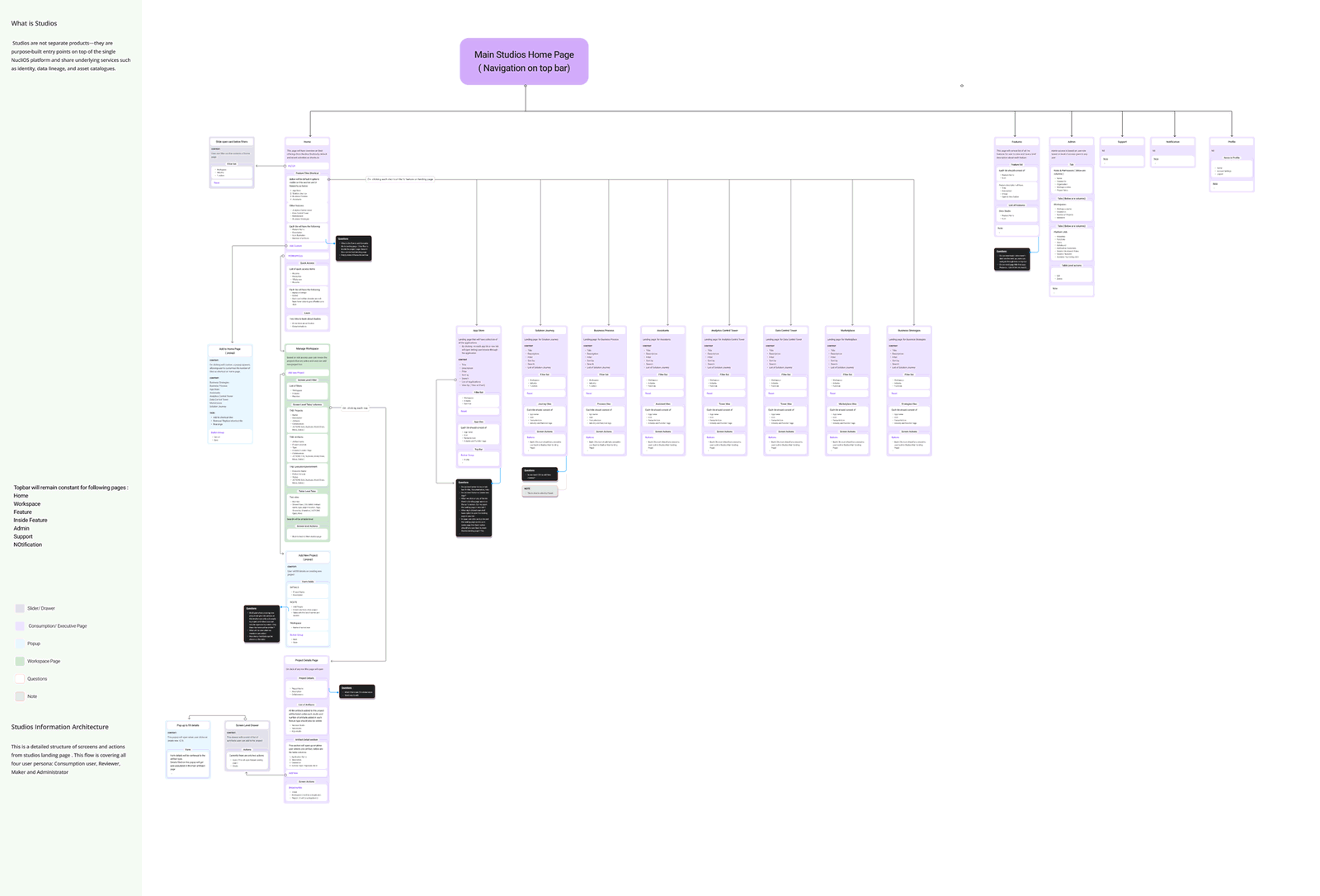
The organization’s decision-making process spans multiple functions and personas, bringing together diverse inputs, perspectives, and actions across the business. While this creates a rich foundation for informed decisions, the overall journey remains fragmented and difficult to trace end to end.
Information, insights, and decisions are often created and managed across disconnected systems and informal channels. As a result, critical context, rationale, and dependencies are not consistently captured or carried forward. This makes it challenging to understand how decisions originate, evolve, and ultimately translate into outcomes. The lack of a unified and traceable flow leads to limited visibility, inefficiencies, repeated work, and misalignment—hindering the organization’s ability to make consistent, scalable, and impact-driven decisions.
Goals
1. Make decision flows visible
2. Capture and preserve decision context
3. Reduce fragmentation into a single source of truth
4. Accelerate and streamline decision-making
5. Build a reusable organizational memory
User Interview
Objective
To uncover how decisions flow across both tangible and intangible touchpoints, and identify gaps and opportunities to optimize the overall journey.
Hypothesis
- Mapping the end-to-end decision flow will help uncover users’ micro-goals, while exposing gaps, lost context, and inefficiencies across the journey.
- A deeper understanding of how information and decisions evolve across functions will enable optimization of the process and improve visibility and transparency.
- While insights today exist in silos across decision intelligence, data-driven practices, and collaboration, the key opportunity lies in stitching them together to create a unified, traceable decision-making ecosystem.
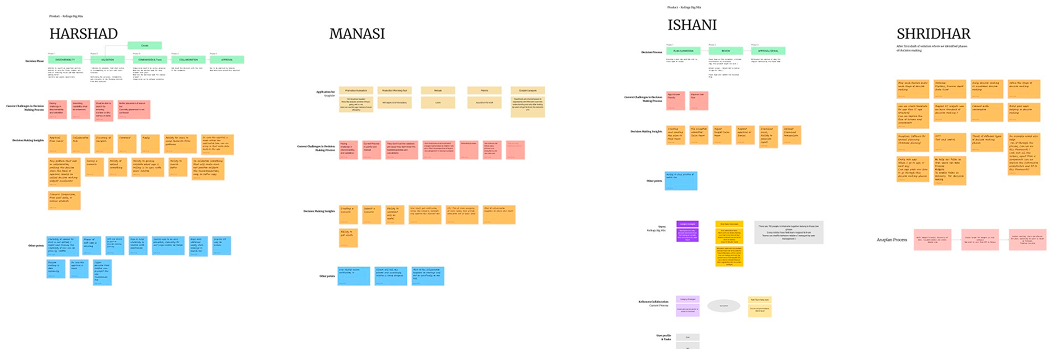
Fig. Screenshot from the Figma file where the interviews were documented
User Research Insights
In the table below the decision-making journey has been captured by before, after and during stages of decision making
Stages of Decision Making
User interviews revealed a consistent decision-making journey, comprising Five distinct stages that apply to all the projects.
DISCOVERABILITY
VALIDATION
COMPARISON & TRACK
COLLABORATION
APPROVAL
Navigating vast datasets, surfacing relevant metrics, filtering noise, and identifying meaningful signals worth investigating
Ability to validate, that what system is recommending is in sync with users’ intuition
Confirming the accuracy, reliability, and relevance of the findings derived from data analysis
Introduce scenario modeling, historical benchmarking, and performance evaluation across similar products, plans, or business conditions.
Cross-functional communication, clarification of rationale, negotiation of priorities, and alignment between stakeholders with different goals and constraints.
Extends beyond a simple sign-off process, incorporating governance, accountability, financial implications, compliance considerations, and execution readiness.
- 01
DISCOVERABILITY
Navigating vast datasets, surfacing relevant metrics, filtering noise, and identifying meaningful signals worth investigating
- 02
VALIDATION
Ability to validate, that what system is recommending is in sync with users’ intuition
Confirming the accuracy, reliability, and relevance of the findings derived from data analysis
- 03
COMPARISON & TRACK
Introduce scenario modeling, historical benchmarking, and performance evaluation across similar products, plans, or business conditions.
- 04
COLLABORATION
Cross-functional communication, clarification of rationale, negotiation of priorities, and alignment between stakeholders with different goals and constraints.
- 05
APPROVAL
Extends beyond a simple sign-off process, incorporating governance, accountability, financial implications, compliance considerations, and execution readiness.
This framework represents a high-level view of how decisions evolve within an organization—from the initial identification of an opportunity to the final approval and implementation of an action. However, in practice, each stage contains its own deeply layered decision-making ecosystem. Every transition to the next stage is supported by multiple micro-decisions, evaluations, discussions, trade-offs, and iterations occurring within teams, systems, and workflows.
Organisation Decision Journey
Fig. 1A
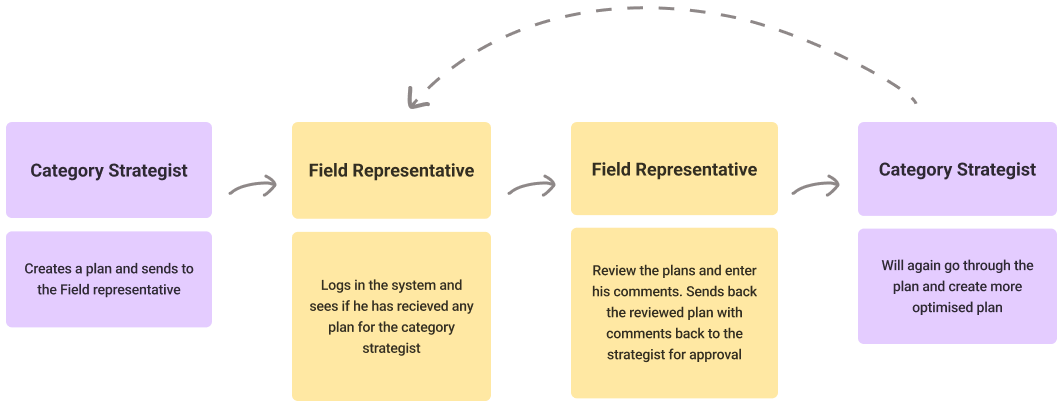

Kellanova Collaboration
The business revolves around enabling a continuous, collaborative assortment planning system where centrally defined strategies (Category Strategist) are validated, adapted, and optimized through field-level insights (Field Representative). The system must support ongoing planogram implementation and dynamic modification, ensuring that any performance-driven decision is seamlessly communicated, validated, and iterated across stakeholders in near real-time.
Fig. 1B
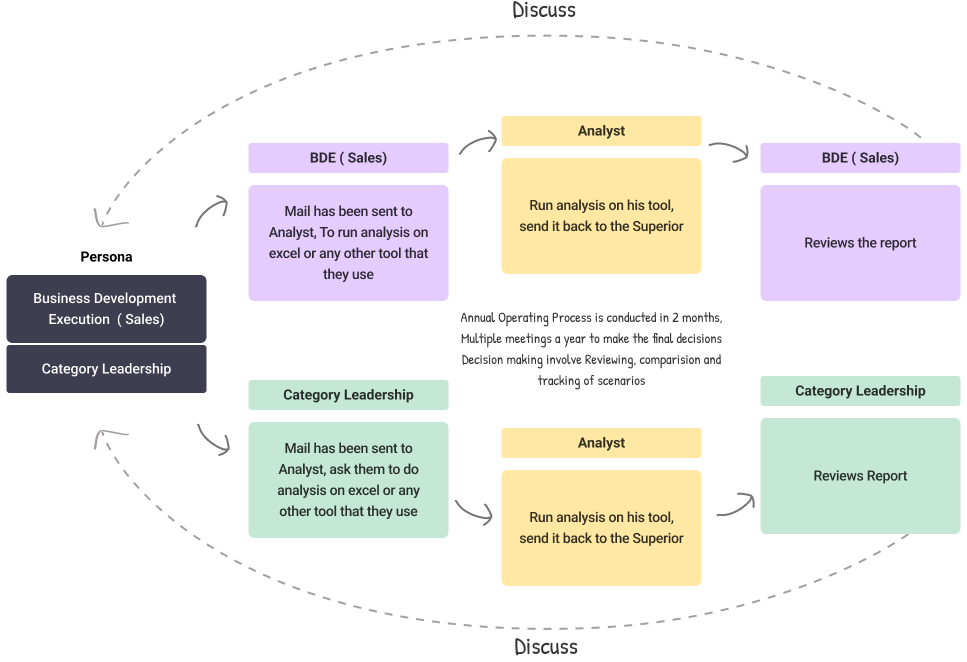
Bi-Monthly Assortment Planning
A system to enable bi-monthly, scenario-driven stocking decisions, where teams can continuously evaluate performance, simulate assortment changes, and optimize inventory distribution, ensuring the right products are available at the right place and time with minimal inefficiencies.
Fig. 1C
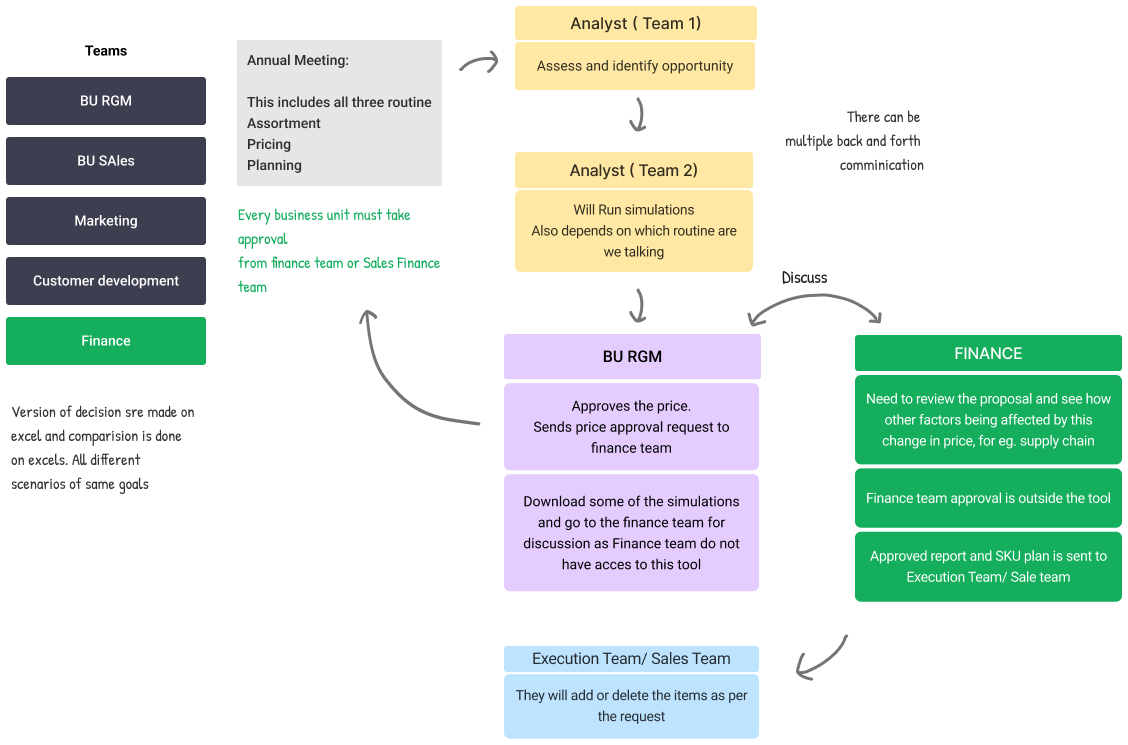
Annual Operation Planning
The business revolves around enabling a multi-functional, collaborative annual planning system that defines and operationalizes the retail assortment, pricing, and promotion strategy across the organization. This system must support end-to-end decision orchestration, where insights are generated, validated, simulated, and approved across multiple teams—including strategy, sales, marketing, analysts, and finance—before being executed in the market. Given the complexity of assortment planning—balancing customer demand, financial targets, and operational constraints—the platform must facilitate continuous back-and-forth collaboration, scenario comparison, and structured approvals, ensuring that decisions are aligned, traceable, and optimized before execution.
Function Decision Flow
Fig. 2A
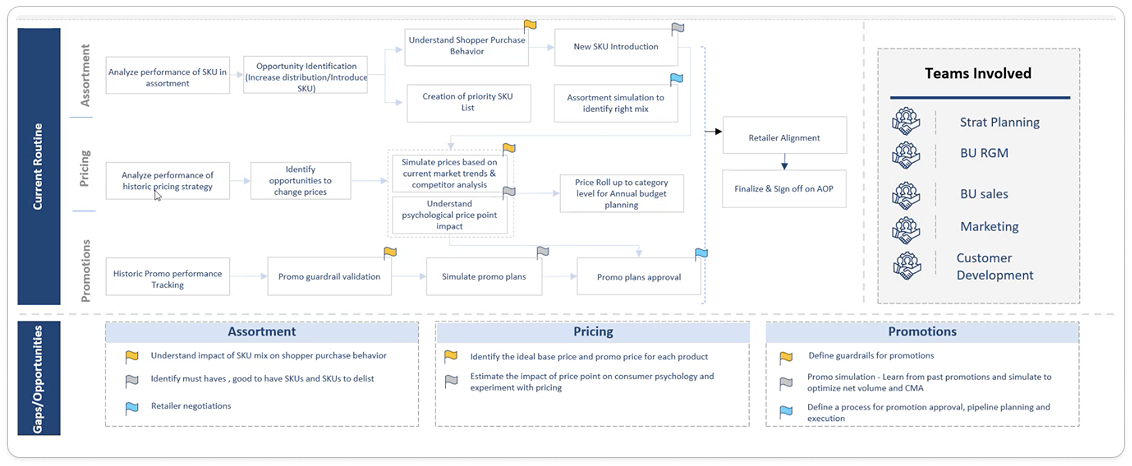
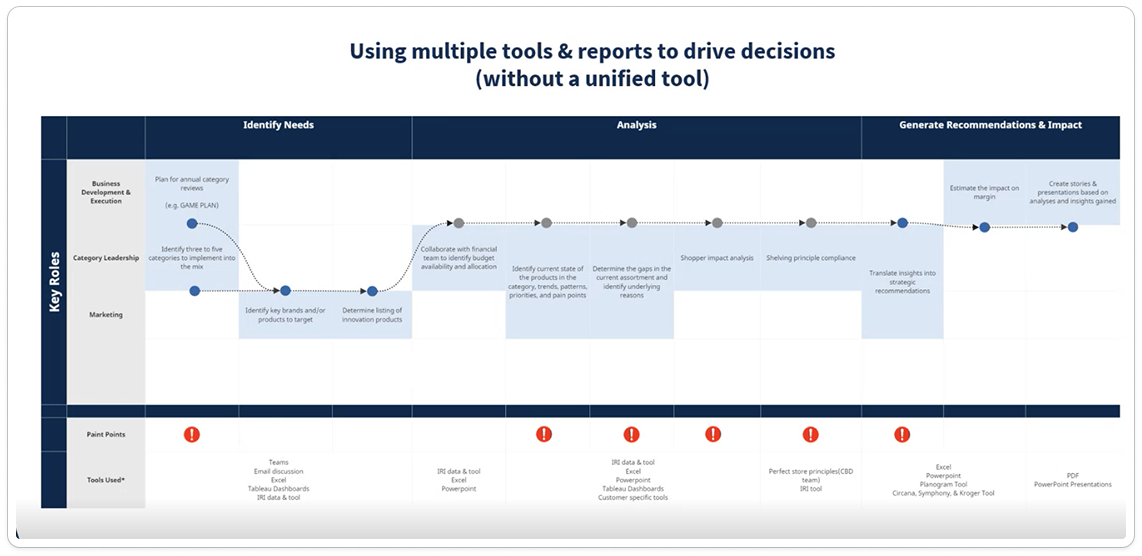
Assortment Decision Making
The information is fragmented across multiple tools and functions are part of decision making various stages. In the above image it has been clearly identified that there are three stages in decision making starting from Identifying Needs, Running analysis and ending with Generating Recommendation reviewing the Impact.
Fig. 2B
RGM
Core Process Pillars
- Assortment: The process focuses on analyzing current SKU performance to identify growth opportunities, understanding shopper purchase behavior, and performing simulations to determine the ideal product mix and necessary delistings.
- Pricing: Teams analyze historical pricing, simulate price changes based on market trends and competitor analysis, and assess the impact of price points on consumer psychology to finalize budget planning.
- Promotions: This pillar involves tracking historical promotional performance, validating guardrails, simulating future plans, and establishing a formalized approval and execution process.
User Persona
The user interview led us to identify three categories of user personas:
- Executive (C-Level Decision Maker)
- Manager (Mid Level)
- Analyst (Beginner to Intermediate Level)
Sarah Chen
Executive | Age: 45

15+ years in strategic leadership, MBA from Stanford. Oversees multiple departments and makes high-level organizational decisions.
"I need to see the full picture quickly, but I'm drowning in reports that don't connect to each other."
Goals
- Make informed strategic decisions quickly
- Ensure decisions align with company vision
- Minimize risk in major investments
- Track ROI on approved initiatives
Challenges
- Information overload from multiple sources
- Lack of visibility into decision flow across teams
- Difficulty validating credibility of insights
- No centralised view of pending approvals
Harshad Muley
Manager | Age: 38

8 years managing cross-functional teams. Bridges executive vision with analyst execution. Previously worked as a senior analyst.
"I spend half my time just moving information between people instead of actually improving our decisions."
Goals
- Translate executive goals into actionable plans
- Coordinate between analysts and leadership
- Ensure data quality and accuracy
- Facilitate smooth approval processes
Challenges
- Manual and redundant handoff processes
- Back and forth communication delays
- Difficulty tracking decision status
- Limited collaboration tools for team reviews
- Multiple tools
Aryan Dey
Analyst | Age: 29

4 years in data analysis, skilled in NucliOS and Excel. Creates detailed models and insights for decision-making.
"I can build great analysis, but I never know if I'm looking at the right data or if anyone actually uses what I create."
Goals
- Translate executive goals into actionable plans
- Coordinate between analysts and leadership
- Ensure data quality and accuracy
- Facilitate smooth approval processes
Challenges
- Manual and redundant handoff processes
- Back and forth communication delays
- Difficulty tracking decision status
- Limited collaboration tools for team reviews
- Multiple tools
Feature List
After reviewing multiple user journeys and analyzing the key challenges and goals across every stage of the decision-making process, we identified recurring patterns and opportunities. Based on these insights, we iterated on potential solutions and documented them along with their descriptions, expected impact, and relevance to different user personas and functions, helping establish a clearer direction for improving collaboration and decision efficiency.
Feature Impact Analysis
Design ideas to optimize the decision-making journey